



Home / Organizational Transformation / Align Practices and Initiatives / More About Aligning Practices and Initiatives
More About Aligning Practices and Initiatives
Sustaining Transformation within Organizations
– 6 Key Areas
Structure, systems, processes, talent, skills, and leadership development need to come together to ensure sustainability.
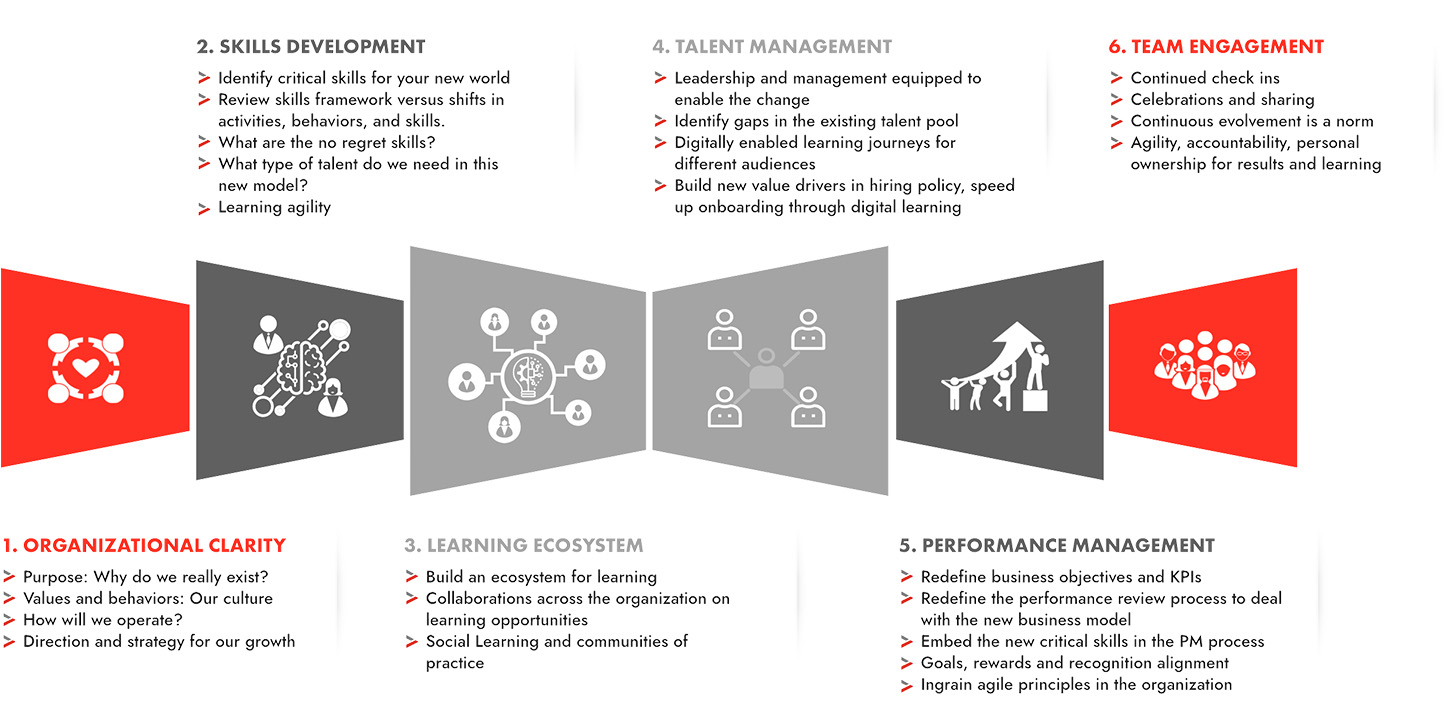
2. SKILLS DEVELOPMENT
- Identify critical skills for your new world
- Review skills framework versus shifts in activities, behaviors and skills.
- What are the no regret skills ?
- What type of talent do we need in this new model?
- Learning agility
4. TALENT MANAGEMENT
- Leadership and management equipped to enable the change
- Identify gaps in the existing talent pool
- Digitally enabled learning journeys for different audiences
- Build new value drivers in hiring policy, speed up onboarding through digital learning
6. TEAM ENGAGEMENT
- Continued check ins
- Celebrations and sharing
- Continuous evolvement is a norm
- Agility, accountability, personal ownership for results and learning

1. ORGANIZATIONAL CLARITY
- Purpose: Why do we really exist?
- Values & behaviors: Our culture
- How will we operate?
- Direction & strategy for our growth
3. LEARNING ECOSYSTEM
- Build an ecosystem for learning
- Collaborations across the organization on learning opportunities
- Social Learning and communities of practice
5. PERFORMANCE MANAGEMENT
- Redefine business objectives & KPIs
- Redefine the performance review process to deal with the new business model
- Embed the new critical skills in the PM process
- Goals, rewards and recognition alignment
- Ingrain agile principles in the organization
The 10 Principles We Employ for Impactful Transformation within Organizations
Our guiding principles for tapping into an organization’s natural strengths.
Work with the existing Corporate Culture
Deeply embedded cultures cannot be replaced with simple upgrades or significant overhaul efforts. To work with your culture effectively, you must understand it, recognize which traits are preeminent and consistent, and discern under what types of conditions these traits are likely to be a help or a hindrance.

Focus on few critical behaviors
The key is to focus on a small number of important behaviors that would have great impact if put into practice by a significant number of people. Select groups of employees who are primed for these few behaviors, those who will respond strongly to the new behaviors and who are likely to implement and spread them.

Keep formal leaders accountable and equip them
Leaders in all parts of the organization are critical in safeguarding and championing desired behaviors, energizing personal feelings, and reinforcing cultural alignment. The signaling of emotional commitment sets the tone for others to follow. The people at the top have to demonstrate the change they want to see.

Demonstrate immediate impact
When people hear about new initiatives and efforts and don’t see any activity related to them for several months, they will disengage and grow cynical. It is extremely important to showcase the impact of cultural efforts on business results as quickly as possible.

Align programs with behaviors
Match the new cultural direction with existing ways of doing business. Informal mechanisms and cultural interventions must complement and integrate with the more common formal organization components.


Change behaviors to affect mindsets
It is commonly believed that behavioral change follows mental shifts, as surely as night follows day. Changes to key behaviors that are tangible, actionable, repeatable, observable, and measurable are a good place to start.

Deploy informal leaders start a movement
Leadership is a natural attribute, exercised and displayed informally without regard to title or position in the organizational chart. These leaders can become powerful allies who can influence behavior through “showing by doing” and further the organization’s transformation efforts.

Link behaviors with business objectives
Select behaviors aimed specifically at improving business performance and can be measured over time.

Take a cross-functional approach
Ideas can spread quickly across organizational departments and functions, as well as from the top down and from the bottom up. One powerful way to spread ideas is through the identified informal leaders. People are often more receptive to changes in “the way we do things around here” when those changes are recommended or shared by friends, colleagues, and other associates.
Manage and maintain the Corporate Culture over time
Strategy, tactics, and technologies will evolve, and organizations need to cope with the changing external environment. Organizations that have had great success working with culture actively monitor, manage, care for, and update their cultural forces.