




In a permanent state of acceleration, relevance is no longer given but must be earned through adaptability and the refusal of mediocrity.
At the dawn of a new era, we must reflect on the accelerating state of work and what it demands from organizations and individuals alike.
What follows is not theory, but a challenge. These are not abstract thoughts, but questions that must be answered in every professional context.
The Shift from Paranoia to Adaptability
In the 1980s, a powerful phrase shaped an era: “Only the paranoid survive”.
It captured the anxiety of technological disruption. It warned leaders not to become comfortable while the ground was shifting beneath them.
Today, in 2026, we are living through something different. Not a single inflection point, but a permanent state of acceleration.
Advancements in technology, digitization, AI agents, automated workflows, and systems speaking to other systems are reshaping how value is created. Those who use these tools effectively will undoubtedly become more productive.
But this is not merely about AI, how much we use it, or how advanced the tools become. It is about new and demanding operating standards.
The Real Risk Is Not AI. It Is Mediocrity.
As tools make organizations more efficient, many will be able to deliver the same output with fewer resources. Productivity rises. Selectivity rises with it.
This means fewer opportunities for those who are average, static, or coasting. This is not pessimism. It is economics. When markets become more efficient, they become more demanding.
Businesses will be more selective. Clients will be more rigorous. Competition will be global. More talented, educated, hungry individuals will be searching for projects, careers, and opportunities to contribute meaningfully.
The question for every professional is simple: Where will you stand?
The world owes us nothing. Not our education or degrees. Not our past success. Not the passport we carry. Even in wealthy environments, opportunity is not guaranteed; it is earned through effort, discipline, and value creation. Every single time.
The Playing Field Is Leveling
AI can draft, it can analyze, it can summarize, it can propose; access to knowledge is no longer a differentiator. So, what makes someone stand out? Not tools, but traits.
In a world where knowledge is abundant, differentiation shifts to how you think, how you behave, how you show up under pressure, and how you refine your craft over time.
There will be very little room for mediocrity in this new reality. This has nothing to do with whether someone uses AI extensively or occasionally. It has everything to do with whether they are continuously evolving and mastering their discipline, with or without technology.
The winners are not necessarily the most technical; they are the most adaptive. To ground this reflection, we use ABAMI as a starting point to ask what this means for us as individuals and as a firm.
What This Means for Us as Individual ABAMI Team Members
If organizations can do more with less, then the definition of the right resource changes.
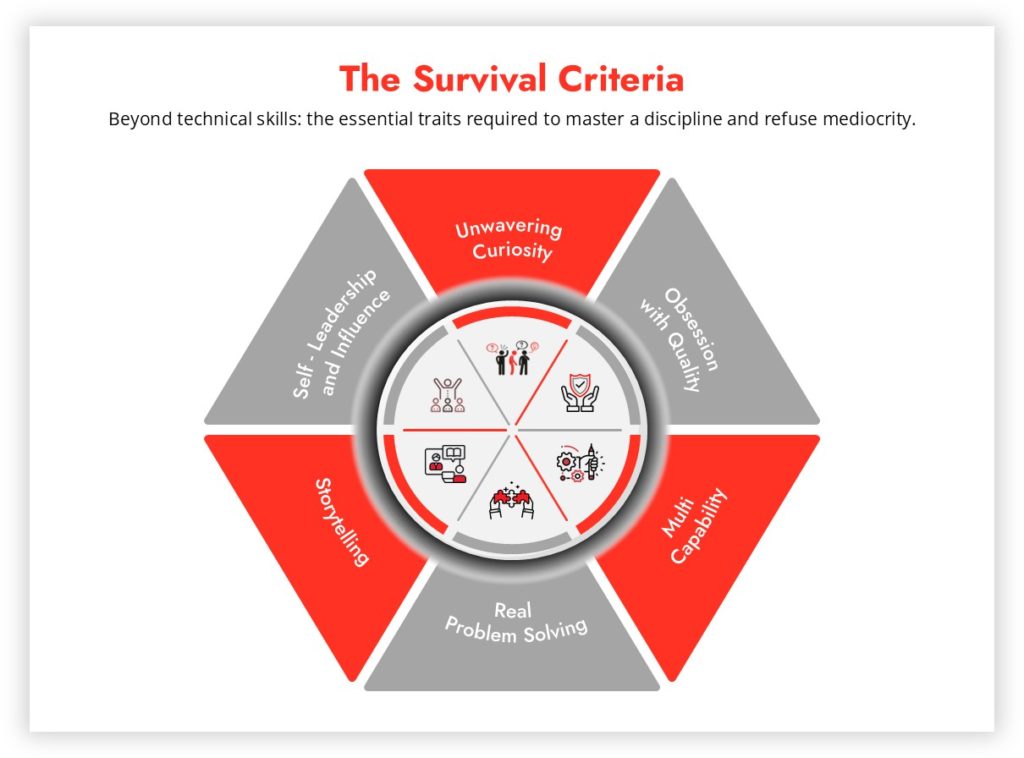
For ABAMI, it comes down to a small, uncompromising set of traits that must define every member of our team. This is not aspirational language; it is a survival criterion.
- Unwavering Curiosity: A relentless desire to learn and build new knowledge or skills, AI-related or otherwise. Curiosity is no longer a personality trait. It is professional insurance.
- Obsession with Quality: Attention to detail. Striving for excellence in everything that carries our name, whether it is a workshop, a proposal, an email, or a conversation. In a selective market, average work is invisible work.
- Multi Capability: The ability to perform across multiple domains and manage complexity without losing focus. Adaptive contributors who can integrate, pivot, and execute are indispensable.
- Real Problem Solving: Balancing risk and results. Not theoretical thinking for its own sake, but practical solutions that work in real client environments.
- Self – Leadership and Influence: The ability to lead oneself in a disciplined manner with little to no supervision, while stepping up to lead others using persuasion that is rooted in logic, knowledge, and facts. Earning the trust of peers and clients consistently.
- Storytelling: The capability to create vivid, meaningful experiences internally and externally. Because strategy without narrative does not move people. These are not soft attributes. They are competitive advantages.
These are the traits we have chosen to define our standard. What are the things you and your team will do to refuse mediocrity?
A Direct Message to the Team
At ABAMI, our internal message is clear: The standard required of us has changed. We must rise to meet it.
The world will not reward doing the minimum required. It will reward value creation. It will reward excellence. It will reward relevance.
Being part of a strong economy or a respected firm does not entitle us to future success. Every mandate, every client, every reputation point must be earned again.
The age of entitlements is over; you want it, earn it.
Doing what we have always done, the way we have always done it, will quietly remove us from consideration. No announcement, no drama, just fewer calls, fewer invitations, fewer mandates.
We have built ABAMI on trust, quality, and impact. We have shaped transformation journeys across complex ecosystems. That credibility matters, but credibility is not immunity.
Reflective Question: If you were to speak with absolute candor about the current state of the market, what would your message to your team be?
What This Means for ABAMI as a Business
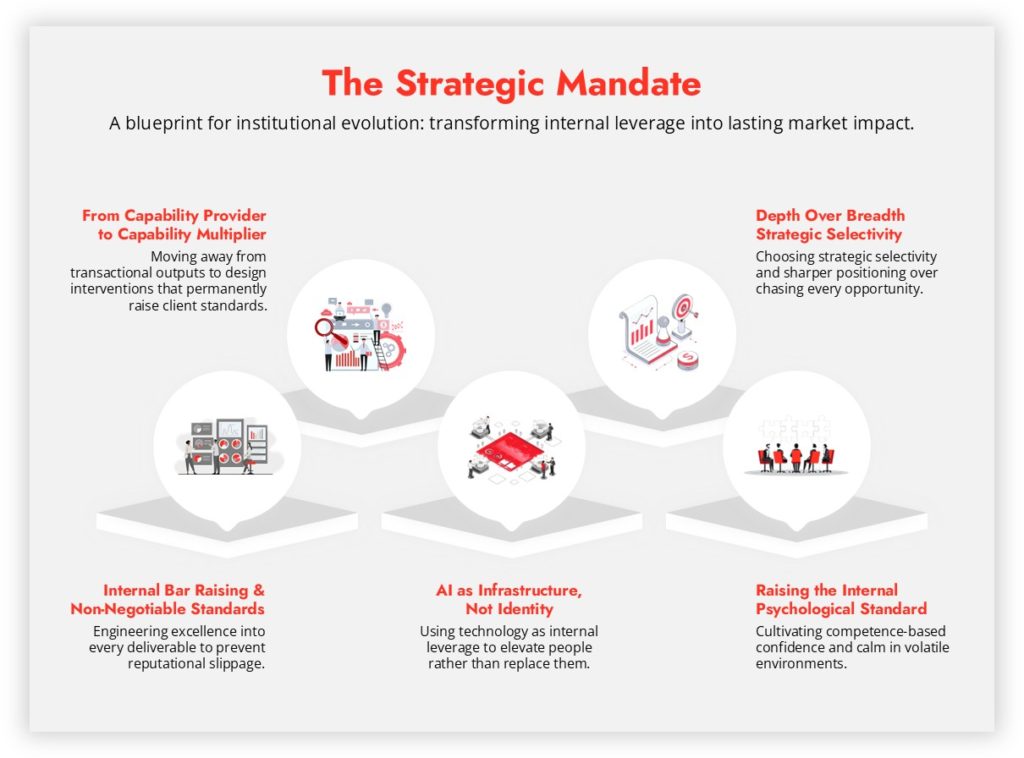
To thrive in this era, we have defined five key pillars for our institutional evolution:
1. From Capability Provider to Capability Multiplier
AI will allow many firms to produce decent output quickly. Slide decks, diagnostics, research summaries, and even frameworks will become commoditized.
ABAMI must move decisively away from being a capability provider and toward being a capability multiplier.
That means:
- Designing interventions that permanently raise a client’s internal standard
- Building internal teams and facilitators who outperform us over time
- Embedding systems and cultures, not delivering isolated events
- Making ourselves strategically unnecessary while becoming intellectually indispensable
The market will reward firms that create lasting impact, not transactional outputs.
2. Depth Over Breadth. Strategic Selectivity.
As competition increases, the instinct may be to chase more opportunities. The smarter move is sharper positioning. In a more selective world, generalists struggle. Specialists dominate.
ABAMI should double down on:
- Organizational transformation in government ecosystems
- Implementing culture architectures tied to measurable performance
- Leadership behavioral shifts that convert strategy into execution
- Developing capabilities that combine skills, knowledge, and lived experiences
If we try to be relevant to everyone, we dilute authority. If we become known for one or two things at exceptional depth, we increase pricing power and demand.
3. Internal Bar Raising and Non-Negotiable Standards.
As more hungry talent enters the market, quality expectations will rise.
ABAMI must institutionalize internal bar raising:
- Every deliverable must feel premium
- Every session must feel personalized and specially curated
- Every proposal must feel impactful
- Every consultant must feel overprepared
- Every document must reflect world-class thinking
In a tighter market, reputational slippage compounds faster than growth.
Excellence must be engineered, not hoped for.
4. AI as Infrastructure. Not Identity.
AI should not define us, but it must silently upgrade us. Not as a marketing language, but as internal leverage. If competitors use AI to lower costs and we do not use it to increase depth, speed, and insight, we fall behind quietly.
The difference is simple: some will use AI to replace people; we must use AI to elevate people.
5. Raising the Internal Psychological Standard
As productivity increases globally, insecurity will increase as well. Many professionals will feel threatened.
ABAMI must cultivate:
- Confidence rooted in competence
- Calm in volatile environments
- Long-term thinking in short-term cycles
If we panic, we react, if we remain composed and adaptive, we lead. Clients in uncertain times look for partners and advisors who radiate clarity, not anxiety.
Reflective Question: As the market tightens and competition goes global, what are the key priorities you would focus on as a business to remain intellectually indispensable?
What Will Resonate in 2026 and Beyond?
In the 1980s, it was “Only the paranoid survive.”
In 2026, it is this: Only the Adaptive Stay Relevant.
Not the loudest, or the busiest, or the most technically equipped, but the most adaptive.
Those who learn faster than the world changes.
Those who refuse mediocrity.
Those who combine competence with character.
Those who continuously evolve their craft.
AI will continue to evolve; markets will continue to tighten. Opportunities will continue to concentrate around those who bring exceptional value.
Our responsibility, individually and collectively, is to evolve faster than the environment around us. Use the examples above as a starting point, but do not stop there.
Define what adaptability means for you – as an individual, a leader, and a business. Write your own list. Raise your own standard. Set your own non-negotiables. Because in this new world, relevance will not be given. It will be earned.
Have a fun-filled journey, exciting times lie ahead for those who are paranoid about relevance and adaptability.
“Stay Foolish and Stay Hungry” because in this new world, only the adaptive will survive.