



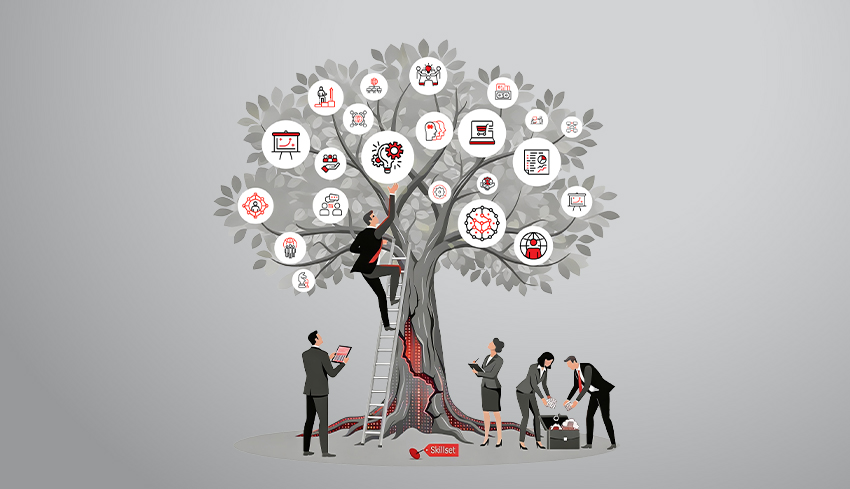
Why continuous learning is the competitive edge your organization cannot afford to ignore.
In a world reshaped by automation and AI, relevance is no longer granted by title or tenure — it is earned, daily, through deliberate skill-building.

The rules of professional survival have been rewritten. A decade ago, a strong CV, a prestigious degree, and the right job title were enough to guarantee a seat at the table. Today, none of those credentials protect you from the accelerating pace of technological change. The only true, enduring asset in the modern economy is skills — and the capacity to continuously build new ones.
This is not a minor shift. It is a fundamental restructuring of what value looks like in the workplace. As artificial intelligence automates routine tasks, as whole industries pivot overnight, and as organizations demand faster, smarter, and more adaptable teams, the question every leader, HR professional, and individual contributor must answer is the same: are you building the skills that tomorrow requires?

Why the Old Playbook No Longer Works
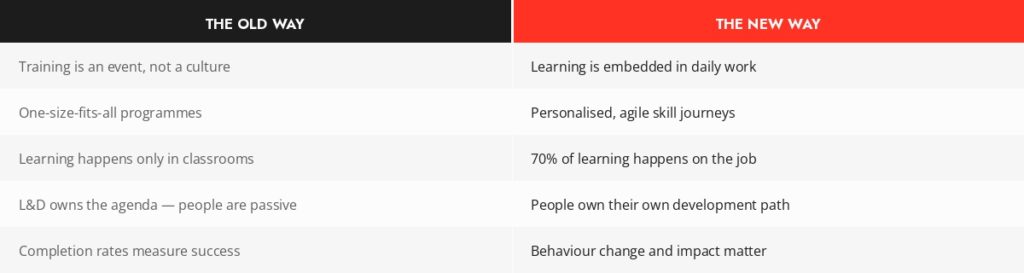
For decades, the dominant model of workplace learning looked the same everywhere: training was an event, not a culture. Employees attended scheduled classroom sessions, ticked completion boxes, and returned to their desks largely unchanged. L&D teams owned the agenda; people were passive recipients. One-size-fits-all programmes were designed for the average learner, which meant they truly served no one.
That model served a slower world. It does not serve this one.
By 2027, half of all current job skills will be obsolete. Eighty-five million jobs are projected to be displaced globally as automation rises. The shelf-life of a professional skill — once measured in decades — is now measured in years, sometimes months. Organizations that continue to treat learning as a periodic event rather than a daily discipline are not just inefficient; they are actively falling behind.
The shift that is required is not merely tactical. It is philosophical.
Knowledge Is Commoditised — So What Actually Sets People Apart?
Here is the uncomfortable truth that AI has made undeniable: knowledge itself is no longer a differentiator. AI can draft, analyse, summarise, and propose. Access to information has never been more democratised. What AI cannot replicate is how you think, how you behave under pressure, how you show up for others, and how consistently you refine your craft over time.
The playing field is levelling. And in a levelled field, the difference between those who thrive and those who plateau comes down to one thing: the quality and intentionality of their learning habits.
There will be very little room for mediocrity in this new reality. High performance is no longer about having access to the right tools — everyone has the tools. It is about whether individuals and organizations are continuously evolving, whether they are mastering their disciplines with or without technology, and whether they are building the rare human capabilities that machines cannot easily replicate.

Learning Agility: The Meta-Skill of the Modern Era
If skills are the new currency, then learning agility is the exchange rate. It is the capacity to learn quickly from experience, to apply new knowledge to unfamiliar situations, and to adapt continuously as the environment changes. According to research from the Korn Ferry Institute, learning agility is one of the strongest predictors of long-term leadership potential and career success.
Critically, agile learners are not born — they are built. Through deliberate habits and intentional mindsets, anyone can develop the qualities that define a powerful learner. The five factors of learning agility provide a practical framework:
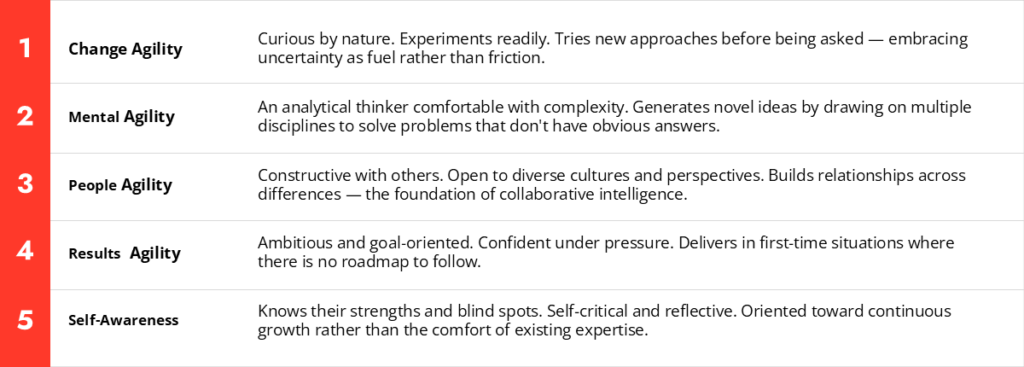
The most effective organizations do not just hire for these qualities — they actively cultivate them through the systems, cultures, and learning environments they build.
Mastery Is Not a Destination — It Is a Daily Discipline
One of the most pervasive myths in professional development is that mastery is something you arrive at. In reality, the people who sustain the highest levels of performance understand that mastery is a practice — a set of daily disciplines repeated with intention, not a credential you earn once and carry forever.
Building genuine skill requires a structured cycle of deliberate effort:

As the philosopher John Dewey observed, we do not learn from experience alone — we learn from reflection on experience. The organizations that hardwire this cycle into their rhythms — team check-ins, project retrospectives, coaching conversations — are the ones that build capability that compounds over time.
The 70-20-10 Framework: Where Real Capability Is Built
One of the most enduring and evidence-backed insights in learning science is that real capability is not built primarily in classrooms. The 70-20-10 framework — widely validated across industries and organizational contexts — reveals that most meaningful learning happens through a very different mix:
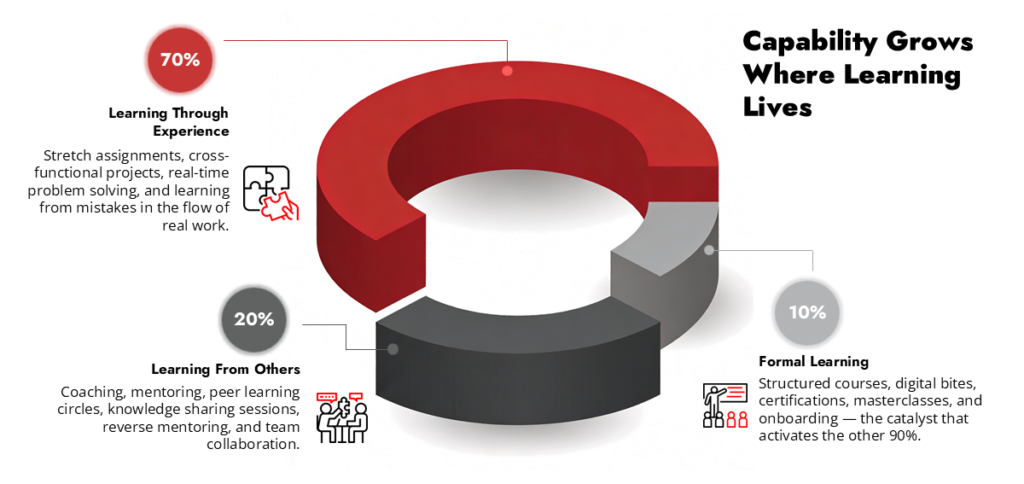
The critical insight here is that formal learning — the 10% — is not the destination. It is the ignition. Without structured, well-designed formal learning to introduce frameworks, build common language, and spark insight, the other 90% remains unstructured and ad hoc. The most effective L&D strategies design an intentional 5-stage blended journey: pre-learning, live or virtual sessions, knowledge bites, community collaboration, and certified champions who sustain the culture long after the programme ends.
Activating the 70%: Turning Everyday Work Into Learning
The biggest driver of real skill-building happens at work — through doing. Yet most organizations leave this 70% entirely to chance. Intentional experience design turns ordinary work moments into powerful development opportunities:
- Stretch Assignments give people challenges beyond their current comfort zone, building new competencies in the context of real stakes and real consequences.
- Cross-functional Projects break silos and expose teams to new perspectives, broadening capability across the organization.
- A Feedback-Rich Culture builds continuous loops where insights from real work accelerate both growth and reflection.
- Expanded Responsibilities gradually increase ownership so that people develop leadership through intentional practice rather than sudden promotion.
Harnessing the 20%: The Power of Human Connection
Human connection accelerates learning faster than any course. The social learning that happens through peer learning circles, coaching relationships, knowledge sharing sessions, reverse mentoring, and cross-entity communities is not a soft supplement to formal training — it is how skills actually stick.
Structured cohorts that share challenges, insights, and wins build capability and community simultaneously. One-on-one coaching transfers tacit knowledge faster than any programme, accelerating growth through trusted relationships. Regular ‘lunch and learn’ sessions and team huddles where colleagues teach each other build a culture of curiosity that is self-sustaining.

Skills Development Is Not a Role-Level Issue — It Is Everyone’s Issue
One of the most important realizations for any organization building a skills-first culture is this: no role, level, or title protects anyone from irrelevance. The imperative for continuous skills development applies equally across every layer of the organization. For early-career talent, the skills that secured a first role are rarely the skills that will sustain a growing career. Building strong learning habits early is the single greatest career investment a person can make. For specialists and experts, deep expertise has a shelf-life. Fields transform, tools are replaced, and yesterday’s best practice becomes today’s liability without continuous renewal. For senior leaders, even at the top, strategy, technology, and stakeholder expectations evolve. Leaders who stop learning lose the trust and credibility needed to inspire the people around them.
Continuous skills development is not a remediation programme for those who are behind. It is the operating system of any high-performing organization.
Four Pillars of an Agile Learning Organization
Building a skills-first culture at scale requires more than a new training catalogue. It requires a systemic shift across four pillars:
1. People Own Their Journey
The shift from “L&D pushes training” to “I own my growth” is the most powerful cultural transformation an organization can make. When personal development is linked to organizational purpose — when people understand not just what to learn but why it matters — commitment accelerates dramatically.
2. Leaders Are Culture Carriers
Culture changes through visible leadership behaviour, not policies. Leaders who share their own learning stories openly, who model curiosity by admitting what they don’t know, who start meetings by asking “what did we learn?” — these leaders are building learning cultures with every daily interaction.
3. Personalised and Blended Journeys
Modular, digital, face-to-face, and gamified experiences — tailored to role, level, and aspiration — woven into the fabric of real work. The modern learner is not well served by generic calendars. They are energised by pathways that feel designed for their specific context and ambitions.
4. Measure What Actually Matters
Beyond completion rates: track behaviour change, skill application, and performance uplift. These are the indicators of real return on learning experience. Organizations that only measure who attended a training session are measuring the wrong thing entirely.
The Learner Journey: From Passive Recipient to Active Owner
The most transformative shift in modern L&D is moving from organization-led training calendars to learner-owned journeys of genuine growth. This five-stage journey maps the transition:
- Envision — Clarify purpose, strengths, and where to grow.
- Explore — Research, discover, and build knowledge through curiosity.
- Act — Apply learning in real work, take on challenges, iterate.
- Reflect — Capture what changed, what was learned, and what comes next.
- Recognise — Celebrate milestones, share wins, and become a learning champion for others.
This is not a linear path — it is a continuous spiral of development. And when embedded into every touchpoint of an individual’s professional life, it creates the kind of capability that organizations cannot buy and competitors cannot easily replicate.
The Bottom Line: Skills Are the Strategy
The organizations that will define the next decade are not those with the largest headcounts or the biggest technology budgets. They are the ones that have made a deliberate, sustained commitment to building human capability — the kind that adapts, the kind that compounds, the kind that gives every individual a reason to bring their best to work every single day.
Skills are the new currency. Learning agility is the exchange rate. And the organizations that invest in both — systematically, intentionally, and at scale — are the ones that will not just survive the disruptions ahead. They will shape them.
The journey starts now.