



A four-phase framework helps organizations align teams, clarify priorities, and turn insights into measurable results.
Strategic planning doesn’t have to be complex or overwhelming. In fact, when approached with a clear and structured framework, it becomes a straightforward and powerful tool for guiding an organization’s future. That’s the focus of this insight: demystifying strategic planning and showing how, by following a practical step-by-step process, any organization can build clarity, focus, and adaptability into its operations.
This guide breaks strategic planning into four manageable phases, each designed to make the process easier to implement and more impactful. Whether you’re leading a nonprofit, growing a startup, or steering a well-established company, this structured approach will help you navigate change, build a future-ready organization, and stay aligned with your goals, without getting lost in complexity.
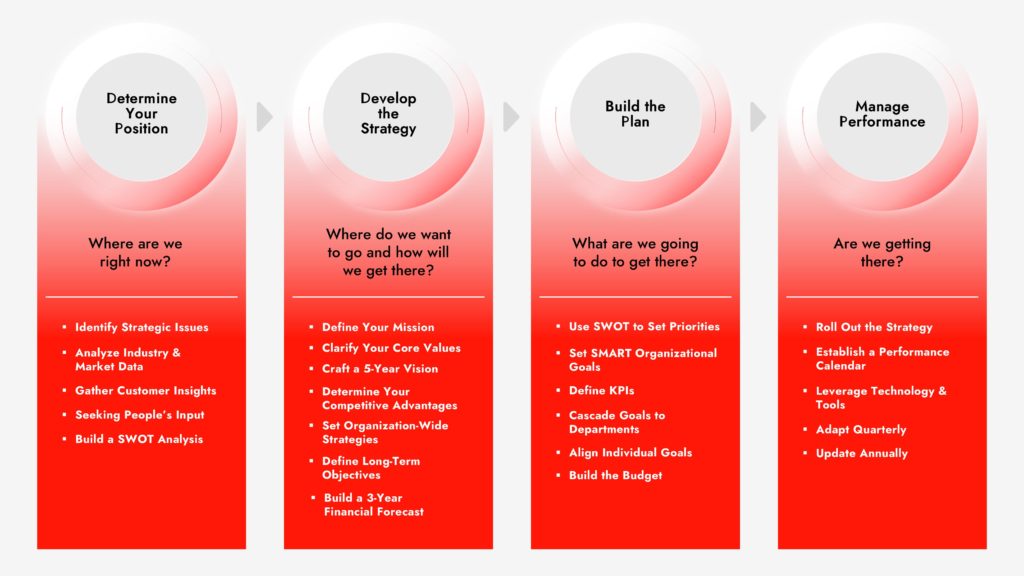
Phase 1: Determine Your Current Position
Before you chart the future, you need a deep understanding of the present.
This phase is about gathering insights and developing a shared understanding of the landscape in which your organization operates. It’s your diagnostic stage where facts replace assumptions and clarity emerges.
Answering the question: “Where are we right now?”
- Identify Strategic Issues: Pinpoint the key challenges and opportunities facing your organization. What are the persistent obstacles? What emerging trends could redefine your industry? Identifying these upfront helps sharpen your focus.
- Analyze Industry and Market Data: Examine market trends, competitive dynamics, customer behaviors, and technological disruptions. Data-driven insights help you anticipate threats and uncover untapped opportunities.
- Gather Customer Insights: Your customers are your best compass. Evaluate their current satisfaction levels, unmet needs, and future expectations. Use surveys, focus groups, and behavioral data to uncover the gaps between what you offer and what they truly value.
- Seeking People’s Input: People see what leadership often misses. Through interviews or anonymous feedback, gather insights on internal bottlenecks, culture, and operational effectiveness. This supports buy-in and uncovers valuable internal perspectives.
- Build a SWOT Analysis: Pull all this data together into a clear SWOT (Strengths, Weaknesses, Opportunities, Threats). This synthesis becomes the foundation for prioritizing actions and setting strategic direction.
Pro Tip: Don’t rush the diagnosis. The quality of your insights determines the strength of your entire strategic plan. Your strategy is as strong as your SWOT.
Phase 2: Develop the Vision and Strategy
With clarity on your current state, it’s time to define your destination and how you’ll get there.
This phase is where vision meets structure. It’s about designing a strategic blueprint that aligns your values, capabilities, and ambitions into a cohesive, forward-looking plan.
Answering the question: “Where do we want to go and how will we get there?”
- Define Your Mission: Reaffirm or redefine your core purpose. Why does your organization exist? Who do you serve, and what value do you deliver?
- Clarify Your Core Values: Identify the non-negotiable beliefs and behaviors that shape your culture. These values guide decision-making, hiring, leadership, and how you navigate challenges.
- Craft a 5-Year Vision: Paint a vivid, compelling picture of what success looks like in five years. A strong vision inspires commitment and provides a reference point for strategic decisions.
- Determine Your Competitive Advantages: What truly differentiates you? Whether it’s innovation, service quality, agility, or brand trust, knowing what sets you apart helps sharpen your market positioning.
- Set Organization-Wide Strategies: These are the high-level approaches that will drive your success. For example: “Expand into new markets,” “Enhance digital capabilities,” or “Develop internal leadership pipelines.”
- Define Long-Term Objectives: Establish a 3-year set of prioritized objectives (ideally no more than six). These should be balanced across growth, customer experience, operational excellence, people development, and innovation.
- Build a 3-Year Financial Forecast: Create high-level financial projections tied to your objectives. Include expected revenue, cost drivers, investment areas, and margins. This brings accountability and feasibility to your strategy.
Phase 3: Build the Operational Plan
Strategy without execution is wishful thinking. This phase translates intent into action.
Here, you convert broad objectives into specific, measurable, and time-bound initiatives. The goal is to mobilize every part of the organization around the strategy.
Answering the question: “What are we going to do to get there?”
- Use SWOT to Set Priorities: Revisit your SWOT analysis and align your most urgent opportunities and threats with your strategic priorities.
- Set SMART Organizational Goals: Break your long-term objectives into 1–2 year SMART goals: Specific, Measurable, Achievable, Relevant, and Time-bound. These become the anchor for performance reviews and progress tracking.
- Define KPIs: Identify the Key Performance Indicators that matter most. For example: Net Promoter Score (NPS), employee engagement rate, cost-to-acquire a customer, or operational efficiency.
- Cascade Goals to Departments: Department leaders should translate organizational goals into team-specific targets. This alignment builds accountability and empowers teams to contribute meaningfully.
- Align Individual Goals: Ensure every team member has clear objectives connected to departmental and organizational goals. This fosters ownership and clarity at every level.
- Build the Budget: Design a one-year budget that supports your strategic priorities. Include resources for capacity building, technology upgrades, marketing, and operational improvements.
Pro Tip: Keep the plan visible and dynamic. Use dashboards and check-ins to keep the strategy at the top of the organization’s mind.
Phase 4: Manage and Monitor Performance
The best strategies adapt as they evolve. Execution is discipline.
This final phase focuses on sustaining momentum and driving results. It ensures your strategy becomes a living framework, not a forgotten slide deck.
Answering the question: “Are we getting there?”
- Roll Out the Strategy: Communicate the plan in a compelling way to all stakeholders. Use visual summaries, videos, and workshops to ensure understanding and buy-in.
- Establish a Performance Calendar: Set regular review intervals – monthly, quarterly, and annually – to evaluate progress, address roadblocks, and celebrate wins.
- Leverage Technology and Tools: Invest in project management platforms, KPI dashboards, and collaboration tools to streamline tracking and execution.
- Adapt Quarterly: Quarterly reviews turn flexibility into resilience.
- Update Annually: Conduct a comprehensive year-end review. What worked? What didn’t? Use those insights to refine your goals and reset your focus for the coming year.
Strategic planning requires a thoughtful, simple, and structured approach that enables organizations to stay focused, aligned, and responsive to change.
When organizations engage in this process with intention, they gain more than just direction; they build a foundation for smarter decisions, stronger team collaboration, and measurable progress.
By applying this framework, organizations can stay on course, adjust effectively, and create lasting value in every stage of their development.
Take the first step to align your vision, empower your people, and future-proof your organization.